Vietnamese Tones Explained: A Simple Guide with Practical Exercises

Vietnamese tones are often described as the most challenging part of learning the language.
But here’s the truth: Vietnamese tones are not random sounds. They are predictable pitch patterns.
Once you understand how they work and train your ear correctly tones become manageable, even for English speakers.
In this guide, you’ll learn:
-
What Vietnamese tones are
-
Why tones matter so much
-
How the 6 tones work in Northern Vietnamese (Hanoi dialect)
-
Common mistakes learners make
-
Practical exercises to train your pronunciation
If you're just starting your language journey, you may also want to read our complete roadmap: Ultimate Guide to Learning Vietnamese (2026)
Why Vietnamese Tones Matter
Vietnamese is a tonal language. This means the meaning of a word changes depending on pitch.
For example:
ma
má
mà
mả
mã
mạ
Each of these words has a different meaning. If tones are incorrect, communication can break down quickly. But this doesn’t mean tones are impossible.
It simply means tone training must come early, not after memorizing hundreds of words.
How Many Tones Does Vietnamese Have?
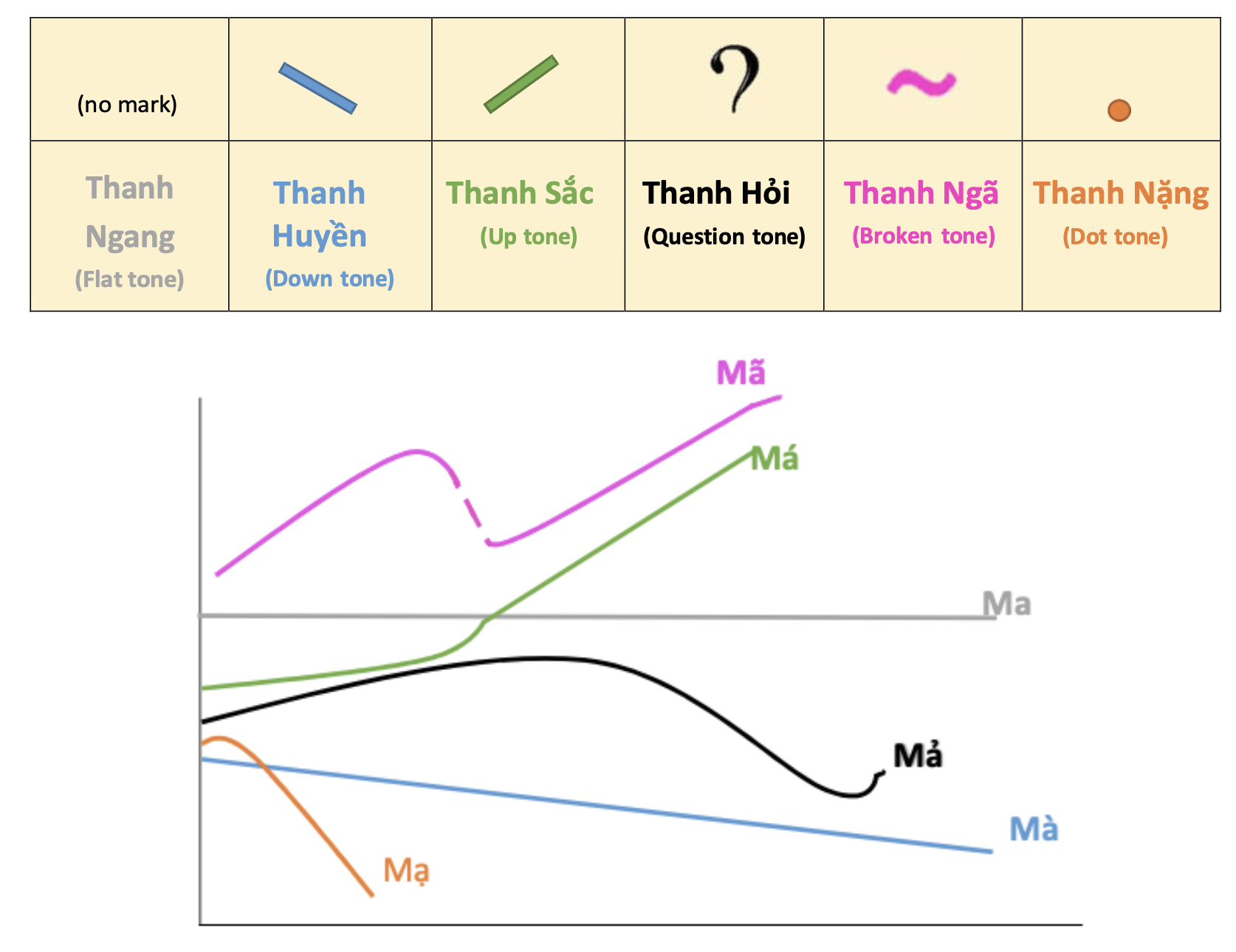
In the Northern dialect (Hanoi), Vietnamese has 6 tones:
-
Level tone (Thanh ngang)
-
Falling tone (Thanh huyền)
-
Rising tone (Thanh sắc)
-
Falling-rising tone (Thanh hỏi)
-
Glottal rising tone (Thanh ngã)
-
Heavy falling tone (Thanh nặng)
Southern Vietnamese merges some tones, but for learners in Hanoi or studying the standard form, it’s best to master all 6.
The 6 Vietnamese Tones Explained Simply
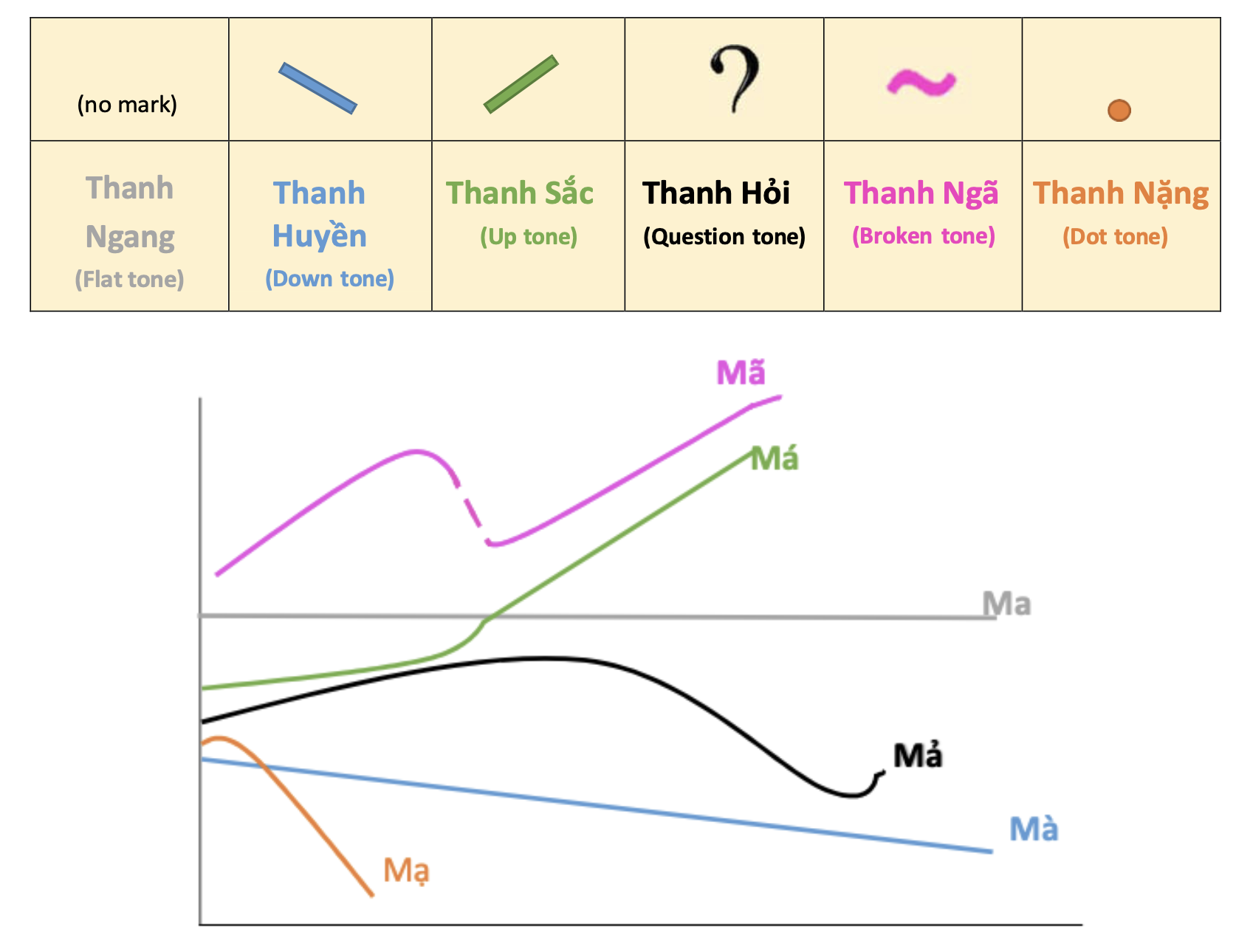
Below is a simplified explanation to help beginners visualize pitch movement.
Level Tone (ngang)
Flat and steady.
Example: ma
No tone mark.
Voice stays neutral.
Think of it as speaking calmly.
Falling Tone (huyền)
Goes downward.
Example: mà
Voice drops gently, similar to a soft statement in English.
Rising Tone (sắc)
Goes upward.
Example: má
Like asking a short question in English.
Falling-Rising Tone (hỏi)
Rises then dips down.
Example: mả
This tone often confuses beginners because the pitch curve is subtle.
Glottal Rising Tone (ngã)
Similar to hỏi but includes a slight voice break or glottal stop.
Example: mã
This tone requires throat control and practice.
Heavy Falling Tone (nặng)
Short, low, and cut off sharply.
Example: mạ
Voice drops quickly and ends abruptly.
For a complete explanation with listening examples and easy practice exercises, watch this video: How to Pronounce Vietnamese Tones: A Simple Guide with Easy Exercises (Vietnamese with Ease)
In this video, you’ll hear:
-
Real pronunciation examples
-
Repetition drills
-
Tone comparison practice
-
Simple exercises you can follow immediately
Common Mistakes When Learning Vietnamese Tones
1. Ignoring tones at the beginning
Many learners focus on vocabulary first. This creates bad pronunciation habits that are harder to fix later.
2. Overthinking tone rules
Tones are muscle memory, not grammar theory. You train tones by listening and repeating consistently.
3. Not practicing minimal pairs
Compare: ma – má – mà – mạ
This trains your ear to detect differences clearly.
4. Speaking too fast
Slow, clear tone production is better than fast incorrect speech.
Practical Exercises to Improve Your Vietnamese Tones
Here are simple daily exercises:
Exercise 1: Tone repetition drills
Choose one syllable (like “ha”) and repeat all 6 tones slowly.
For example: ha, hà, há, hả, hã, hạ
Exercise 2: Minimal pair listening
Listen to recordings and identify tone differences before speaking.
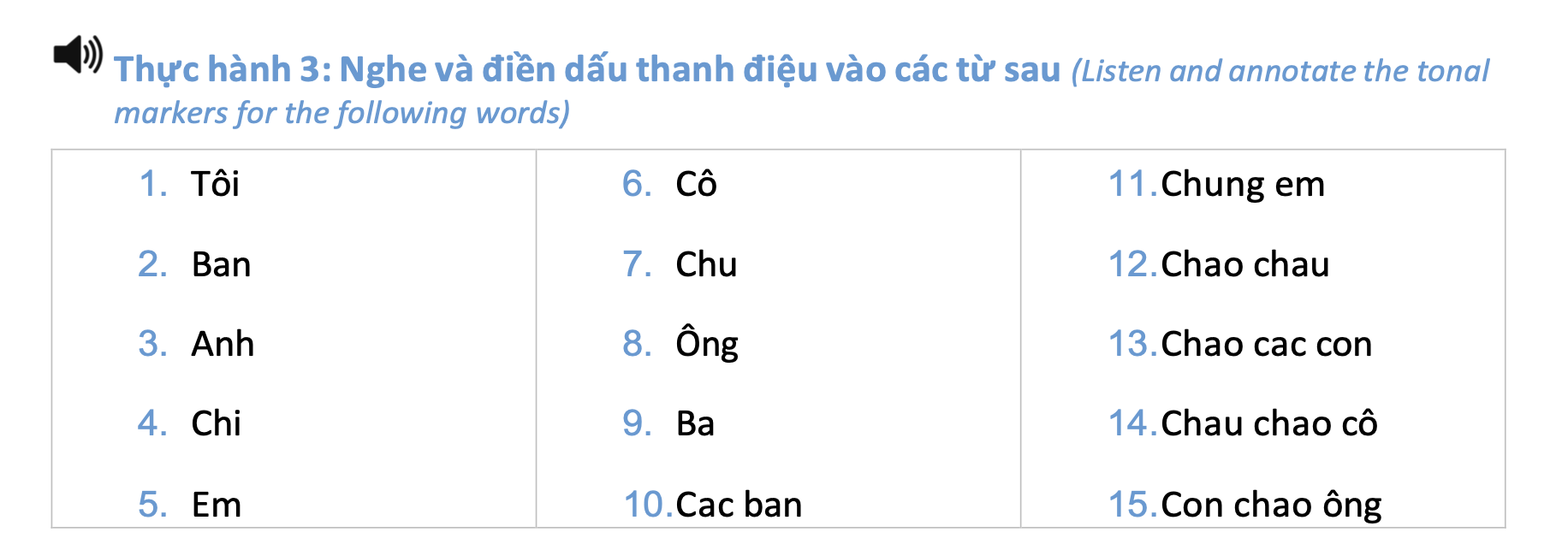
Exercise 3: Record yourself
Compare your voice with native pronunciation.
Exercise 4: Practice with a native teacher
Immediate correction prevents fossilized mistakes.
How Tones Fit into the Bigger Picture
Tones are not separate from vocabulary and grammar. They are foundational.
If you're planning to learn Vietnamese seriously, tones should be your first focus, before complex sentence structures.
For a complete beginner roadmap that explains how tones connect with grammar, vocabulary, and real-life communication, read: Ultimate Guide to Learning Vietnamese (2026)
Learn Vietnamese with Structured Tone Training
At iSpeak Vietlingo, tone training is not an afterthought. It is the starting point.
Our teaching approach, based on the Vietnamese with Ease method, focuses on:
-
Sound-first learning
-
Guided repetition
-
Real-life application
-
Cultural context
Students who train tones correctly from the beginning often progress faster and feel more confident speaking.
If you’re living in Hanoi or planning to move here, you can explore:
👉 Vietnamese Courses in Hanoi
👉 Book a Free Trial Lesson
Final Thoughts
Vietnamese tones are not impossible. They are simply new.
With structured listening, repetition, and guided correction, you can train your ear and your voice effectively. The key is not memorizing more words. It’s mastering sound patterns first. And once tones become natural, the rest of the language becomes much easier.
You should also read:

Best Way to Learn Vietnamese for Expats in Vietnam (Especially in Hanoi)
Are you an expat living in Hanoi or another Vietnamese city and wondering how to learn Vietnamese effectively without wasting time or getting overwhelmed? You’re not alone. Many expats struggle to find a method that fits their busy lifestyle, language background, and cultural goals. At…
Continue reading...
What Matters Most to Vietnamese People? Work, Love, Family, Money, or Friends? (And why it matters if you live or do business in Vietnam)
If you're living, working, or doing business in Vietnam, this question can unlock powerful insights: What do Vietnamese people value the most in life? In many countries, work is the top priority. But in Vietnam, while people work hard, sometimes even holding multiple jobs, they…
Continue reading...
5 Common Mistakes Foreigners Make When Learning Vietnamese (And How to Avoid Them)
Learning Vietnamese can be an exciting yet challenging journey, especially for foreigners who are new to tonal languages or Southeast Asian cultures. At iSpeak Vietlingo, we’ve worked with hundreds of learners from around the world and we’ve noticed that many of them make the same…
Continue reading...Start Your Vietnamese Journey Today
Get your copy of 'Vietnamese with Ease' and begin mastering the Vietnamese language with confidence and cultural insight.
Order Your Copy Now